
This website uses cookies so that we can provide you with the best user experience possible. Cookie information is stored in your browser and performs functions such as recognising you when you return to our website and helping our team to understand which sections of the website you find most interesting and useful.

Finland
Kuhmo Au + Ni, Finland
Status
- 100% owned, Tier 1 Project.
Target
- Orogenic gold, intrusion-related gold (IRGS)
- Komatiite-hosted nickel
Location and Setting
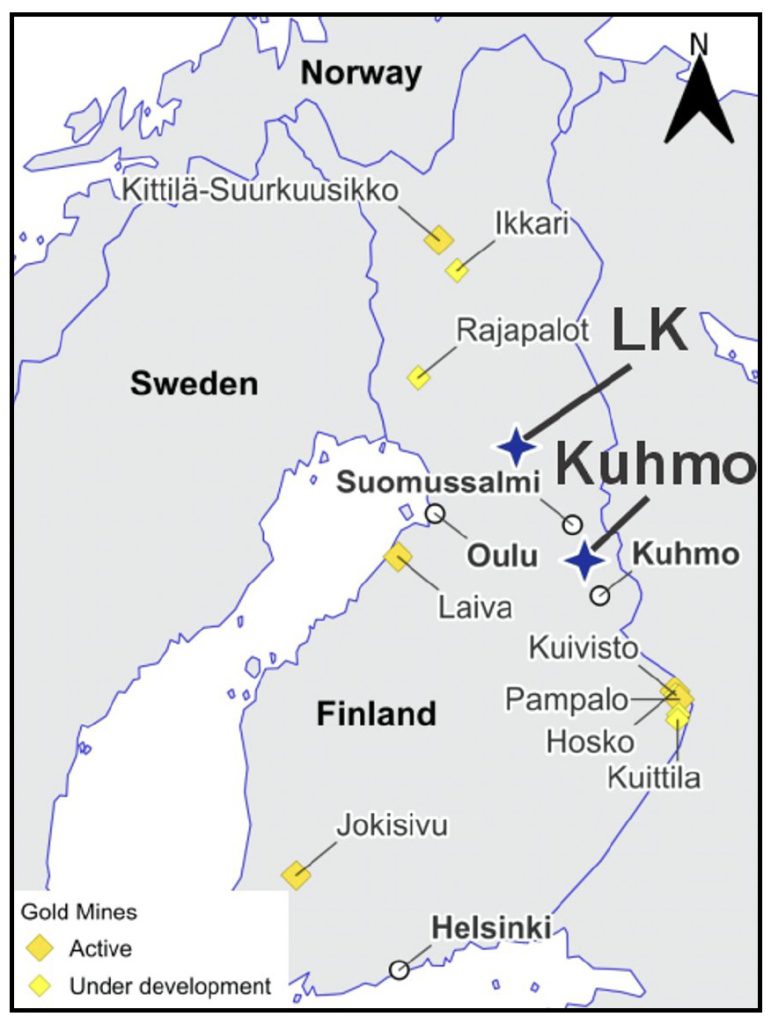
The Kuhmo Project is located in Eastern Finland, between the towns of Suomussalmi (15 km northwest) and Kuhmo (25 km southeast). The project has excellent access via several major paved and gravel/dirt roads, a railway line which crosses the project area, and the port city of Oulu is located ~175 km to the west.
Suomu-Kuhmo is a belt-scale, exploration-stage project located on the Kuhmo greenstone belt, which forms the central part of a 220 km long and up to 10 km wide north-south trending Archean Tipasjärvi-Kuhmo-Suomussalmi (TKS) greenstone belt complex in eastern Finland.
Geology
The Archean-aged Kuhmo greenstone belt is a 220 km long complex in eastern central Finland. While historically noted for its nickel, GT Resources has identified the belt as a premier target for orogenic and intrusion-related gold.
The belt features a structural setting remarkably similar to Canada’s Abitibi Subprovince. The Ronkaperä formation sandstones and conglomerates were deposited in basins along major north-south faults 60-90 million years after the main stage of volcanism. These “Timiskaming-type” sediments act as a major vector for gold exploration, marking the deep-seated “breaks” that served as primary conduits for gold mineralization.
The Kuhmo greenstone belt has a documented history of Archean orogenic gold occurrences associated with major shear zones and favourable volcanic-sedimentary stratigraphy, and the broader Tipasjärvi-Kuhmo-Suomussalmi belt complex has documented komatiites and related intrusives known to host magmatic nickel-copper-PGE sulfide deposits.
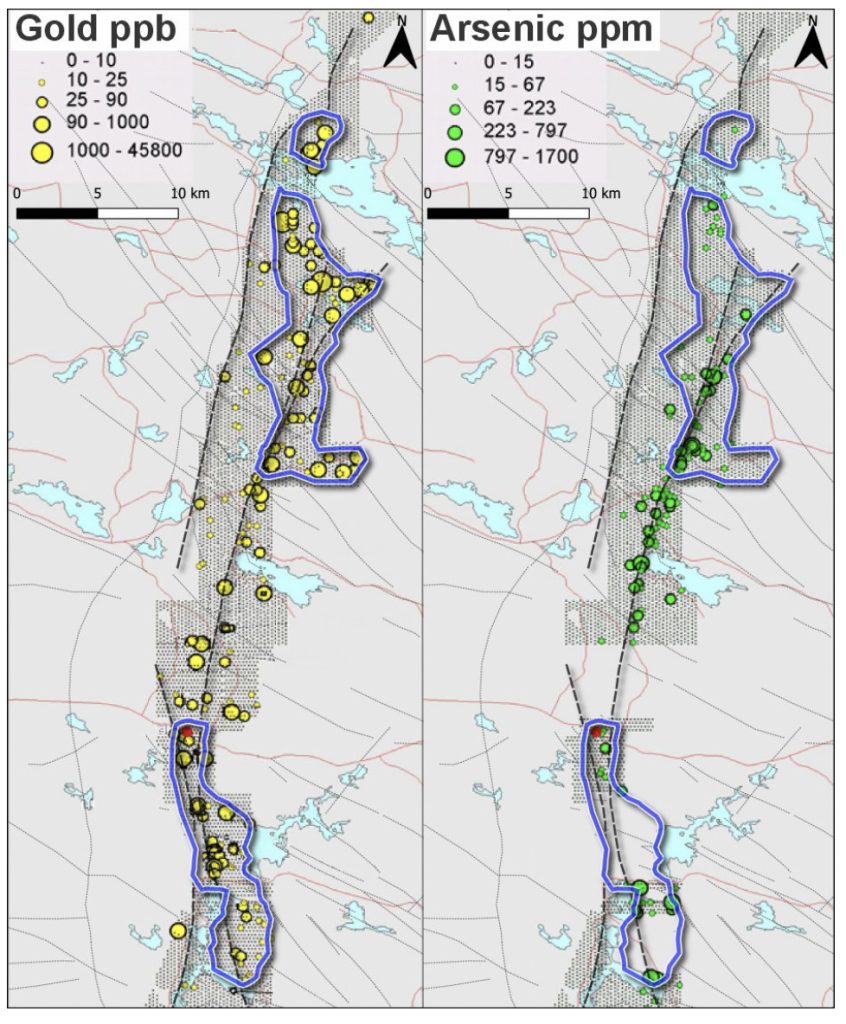
Exploration activities on the Kuhmo greenstone belt is supported by an extensive GTK government dataset which includes bedrock and structural mapping coverage, ~22,000 individual till samples with lithogeochemistry, modern geophysical surveys, and historical drilling and assay compilations, allowing GT to utilize robust historical datasets at low cost to enhance confidence in modern target generation and interpretation on the Kuhmo project.
The current project footprint covers approximately 44 km of the belt.
Mineralization
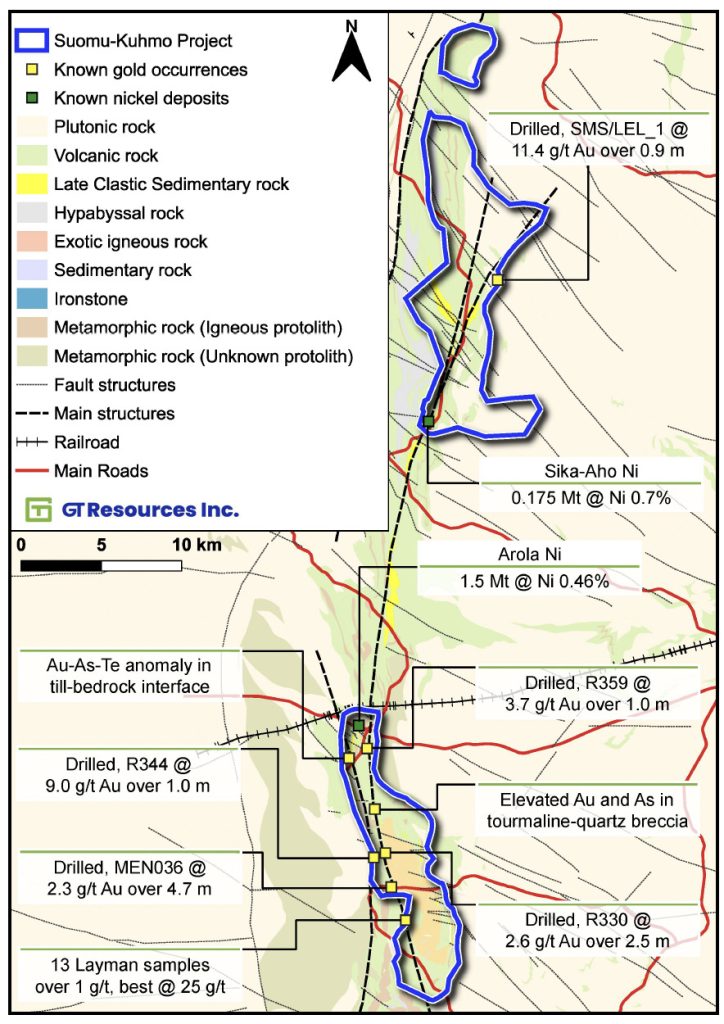
Limited drilling within the Kuhmo project has returned gold intercepts including:
- 11.4 g/t Au over 0.9 m
- 2.3 g/t Au over 4.7 m
Kuhmo mineralization is noted across a wide range of rock types including mafic volcanics, metasediments, banded iron formation, mica schists, and komatiitic units, with gold mineralization concentrated within shear zones during orogenic events.
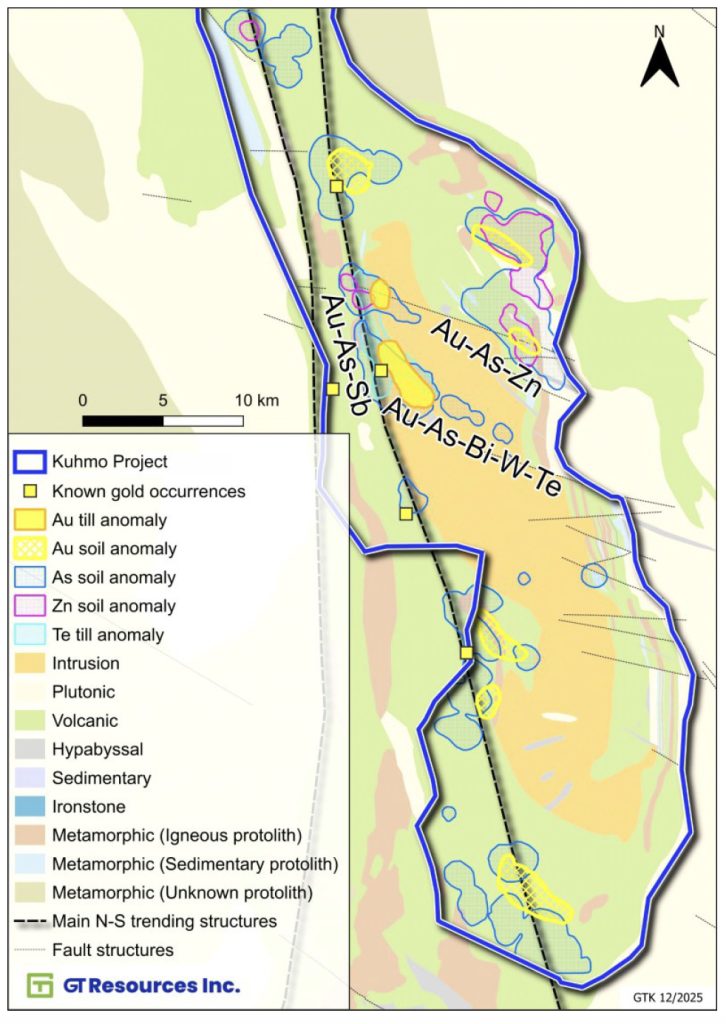
The gold targets at Kuhmo are structurally controlled by north, northwest, and northeast-trending faults and shear zones, particularly the main N-trending Kuhmo shear zone which is intersected by subsidiary structures acting as traps for fluid flow and gold deposition. Gold-bearing quartz-tourmaline breccias observed at Kuhmo (Aittoranta occurrence) are similar to other Archean gold mines in the Abitibi.
Available literature indicates mineralization is associated with late Archean deformation (D3-D4 in the local deformation sequence) between approximately 2.7 Ga to 2.65 Ga, consistent with orogenic lode-gold timing. Pathfinder geochemistry and historical deposits and occurrences from the belt include elevated Sb-Te-W, As, Bi, and S pathfinder elements associated with mineralization, which used in conjunction with extensive GTK till sampling geochemistry datasets allow for vectoring on priority target areas supported by mapped structures.
Land Status
The reservation area is 12,300 ha and was granted at the end of 2025 by the mining authority which remains valid for the following two years. None of the reservation area is located on protected Natura 2000 lands.
Komatiite-hosted Nickel
The Kuhmo belt is also recognized as hosting komatiite-associated Ni-Cu-PGE magmatic sulfides, from primary cumulate-hosted sulfide emplacement and higher-grade remobilized sulfide deposits. Key examples of Kuhmo-hosted nickel are the Sika-Aho and Arola deposits located within the Kuhmo belt. These deposits have demonstrated potential for elevated Ni/Cu ratios, and elevated Au associations.
GT is leveraging broad, belt-scale historical GTK exploration datasets, including detailed structural and bedrock geological mapping and widespread till geochemical sampling, in conjunction with understood mineralization controls, to generate refined priority gold and nickel-copper-PGE target areas for follow-up work and drilling on the Kuhmo project.
A Historical Resource Estimate on the Arola Deposit of the Kuhmo project is quoted as 1,500,000 tonnes @ 0.46% Ni1 by Outokumpu (1998 historic Outokumpu company report). A Historical Resource Estimate on the Sika-Aho Deposit of the Kuhmo project is quoted as 175,000 tonnes @ 0.66% Ni2 (Heino, T., 1998).
The parameters, methodology and categories used are not known, and thus the reliability of the estimate cannot be determined; however, it is still considered relevant as the historic diamond drilling supporting the estimate provides a guide for future exploration.
Next Steps
The company plans to relog and re-sample historic core held by GTK this winter. Most of the drill holes in the Kuhmo belt targeted nickel mineralization and were not sampled for gold. The company also plans to fly a detailed magnetic survey followed by infill till sampling, mapping, and prospecting this spring. This data will be compiled to generate drill targets for testing this fall.
Disclaimer – Historical Resource Estimate – Sika-Aho and Arola Deposits
Readers are cautioned that the Company has not attempted to verify historic mineral resource estimates and therefore readers should not place any reliance on any historical estimate. A qualified person has not done sufficient work to classify a historical estimate as a current mineral resource; additionally, a qualified person has not yet determined what work needs to be done to upgrade or verify a historical estimate as current mineral resources or mineral reserves; however, it is still considered relevant as the historic diamond drilling supporting the estimate provides a guide for future exploration.
The Company is not treating any historical estimates as current mineral resources.
The Arola nickel deposit hosts a historic resource estimate of 1,500,000 tonnes grading 0.46% Ni1
The Sika-Aho nickel deposit hosts a historic resource of 175,000 tonnes grading 0.66% Ni using a 0.35% Ni cut-off2
References
11998 Outokumpu historic company report, not a Ni43-101 compliant historic mineral resource estimate.
2Heino, T., 1998. HYRYNSALMI, Puistola 1 (kaivosrekisteri No 5657/1) ja Paatola 1 (kaivosrekisteri No 5619/1) nikkeliesiintymän mineraalivarantoarvio. Geological Survey of Finland, Archive report, M19/4421/-98/1/10, 33 pp.